


Introduction
Car insurance pricing has traditionally relied on broad assumptions, age, location, credit score, and historical averages. While convenient for insurers, this system often penalizes safe, low-mileage drivers who pose less real-world risk. Usage-based car insurance (UBI) challenges this model by tying premiums directly to how and how much you drive.
As technology advances, UBI is rapidly moving from optional experiment to mainstream pricing model. According to the Insurance Information Institute, usage-based programs are among the fastest-growing segments in personal auto insurance as insurers seek more accurate, behavior-driven risk assessment.
This article explains how usage-based car insurance works, who benefits most, the risks to consider, and how driving smart can translate directly into lower premiums.
What Is Usage-Based Car Insurance?

Usage-based car insurance is a pricing model that adjusts premiums based on real driving behavior rather than static demographic factors.
Insurers collect data through:
- Smartphone apps
- Plug-in telematics devices
- Built-in vehicle systems
This data is analyzed to assess risk more precisely. Research summarized by McKinsey & Company shows that telematics-based pricing improves loss prediction accuracy while rewarding safer drivers.
Unlike traditional insurance, UBI creates a direct link between behavior and cost.
How Usage-Based Insurance Works
While programs vary by insurer, most UBI policies track similar driving metrics:
- Mileage and frequency of driving
- Speed relative to road limits
- Hard braking and rapid acceleration
- Time of day (day vs late-night driving)
- Phone use while driving
Insurers use these data points to generate a driving score that influences discounts or in some cases, rate adjustments.
Providers like Progressive and Allstate publicly outline how telematics data feeds into premium calculations.
The Two Main Types of Usage-Based Insurance
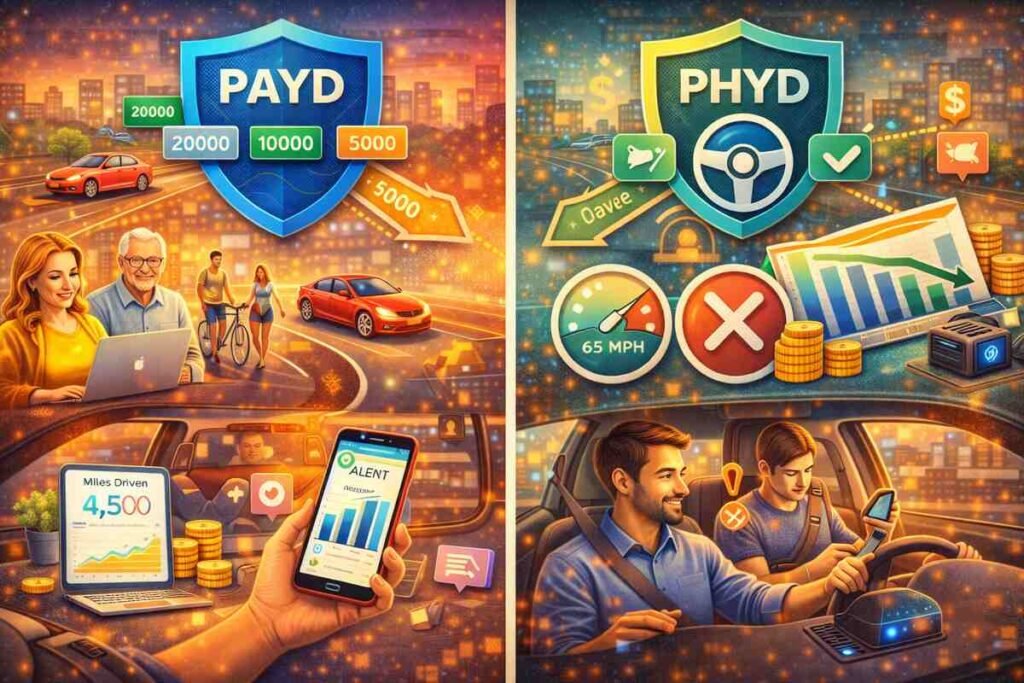
Pay-As-You-Drive (PAYD)
PAYD programs focus primarily on mileage. The less you drive, the less you pay.
Best for:
- Remote or hybrid workers
- Retirees
- Urban drivers with limited car use
Mileage-based pricing reflects real exposure rather than assumed risk.
Pay-How-You-Drive (PHYD)
PHYD programs evaluate driving behavior.
Safe habits, smooth braking, consistent speeds, minimal distractions, result in discounts. Poor driving may reduce savings or increase rates depending on the insurer.
According to NerdWallet, PHYD programs offer the largest savings potential for consistently cautious drivers.
How Much Can You Really Save?
Savings vary widely, but they can be significant.
Insurer disclosures and third-party analysis show that many UBI participants save between 10% and 30%. Some drivers see even higher reductions. Progressive’s Snapshot program reports savings of up to 30% for top-tier drivers.
Factors influencing savings:
- Annual mileage
- Driving consistency
- Urban vs rural environments
- Time-of-day driving patterns
For low-risk drivers, UBI can outperform traditional discounts.
Who Benefits Most From Usage-Based Insurance
UBI is not for everyone, but it is highly effective for certain profiles:
- Low-mileage drivers
- Defensive drivers
- Remote workers
- Families with secondary vehicles
Analysis from ValuePenguin confirms that drivers who control when and how they drive benefit most.
High-risk or high-mileage drivers may see limited savings.
Privacy and Data Concerns Explained

One of the biggest hesitations around UBI is data privacy.
Telematics programs collect detailed driving information, raising concerns about surveillance and data misuse. Insurers generally disclose data usage policies, and regulatory guidance from the National Association of Insurance Commissioners requires transparency.
Key privacy points:
- Data is used for underwriting and discounts
- Location tracking may be limited or anonymized
- Participation is typically voluntary
Understanding the terms before enrolling is essential.
Common Myths About Usage-Based Insurance
Myth 1: Rates always go up
Many programs only offer discounts, not surcharges.
Myth 2: One bad drive ruins savings
Most programs average behavior over time.
Myth 3: Only young drivers benefit
UBI rewards behavior, not age.
Clarifying these myths helps drivers make informed decisions.
How to Drive Smart and Maximize Savings
Drivers can actively influence outcomes by:
- Avoiding aggressive acceleration and braking
- Limiting late-night driving
- Reducing distractions
- Combining trips to reduce mileage
Safe driving habits align financial incentives with road safety.
Is Usage-Based Insurance the Future?
Industry forecasts from Deloitte suggest that telematics-based pricing will continue expanding as vehicles become more connected.
As data accuracy improves, UBI may become the default model, replacing traditional risk assumptions with real behavior.
For drivers, this represents a shift toward fairness and control.
Final Thoughts
Usage-based car insurance changes the rules of pricing. Instead of paying for assumptions, drivers pay for reality. For cautious, low-mileage drivers, this model offers transparency, control, and real savings.
By understanding how programs work, addressing privacy concerns, and driving smart, consumers can turn everyday habits into long-term financial benefits.
In auto insurance, behavior is becoming the most valuable currency.