


Hidden Discounts That Could Cut Your Premium in Half
Most drivers believe that car insurance prices are non-negotiable that once you pick a company and sign a policy, you’re stuck paying the same rate year after year. But in 2025, that couldn’t be further from the truth. The reality is, hundreds of discount car insurance programs exist, many of which go completely unnoticed by everyday drivers. By knowing where to look, you could unlock savings that dramatically reduce your monthly premiums without compromising protection.
According to the Insurance Information Institute (III), U.S. drivers overpay by an average of $400 to $700 per year simply because they’re unaware of available discounts. Whether you’re a safe driver, a student, or a hybrid car owner, there’s likely a hidden program designed to reward your habits.
This guide uncovers the top discount car insurance programs most people don’t know about, how they work, and how to qualify for them.
1. Telematics Programs for Safe Drivers
Best for: Drivers with consistent, cautious habits.
Telematics programs use sensors or mobile apps to monitor driving behavior speed, braking, mileage, and phone use—and reward low-risk drivers with premium discounts.
Popular Telematics Programs:
- Progressive Snapshot – Save up to 25% by avoiding hard braking and nighttime driving.
- State Farm Drive Safe & Save – Tracks via smartphone and offers continuous savings for cautious driving.
- Allstate Drivewise – Rewards both safe driving and low mileage.
Example:
Carmen enrolled in Drive Safe & Save and improved her braking habits after reviewing her driving reports. Within six months, she received a 20% discount on her premium.
Pro Tip: Most telematics apps provide real-time feedback treat them like a coach, not a critic.
Research Insight: The Harvard Business Review found that insurers increasingly rely on AI-driven telematics to offer fairer, personalized premiums.
Takeaway: Safe driving not only protects you it pays you back.
2. Low-Mileage and Work-from-Home Discounts

Best for: Remote workers or part-time commuters.
If you drive less than 7,500 miles per year, you may qualify for a low-mileage discount. In 2025, insurers are offering even deeper savings for hybrid and remote workers whose daily commutes have vanished.
How It Works:
- Your insurer calculates your average annual mileage.
- Lower miles = lower risk = lower premium.
Example:
When Michael transitioned to remote work, he updated his insurer with new mileage data and saved $280 annually.
Pro Tip: Use telematics or odometer verification tools to prove your lower usage.
Research Insight: The National Association of Insurance Commissioners (NAIC) confirms that reduced driving can lower premiums by up to 15% for qualifying drivers.
Takeaway: Working from home isn’t just comfortable it’s cost-efficient for your car insurance too.
3. Pay-Per-Mile Insurance Programs
Best for: City dwellers, hybrid workers, or retirees.
Pay-per-mile programs are growing fast. These plans base premiums on how much you actually drive perfect for people who keep their cars parked most of the week.
Top Pay-Per-Mile Providers:
- Metromile: Charges a base rate plus a few cents per mile.
- Nationwide SmartMiles: Ideal for low-mileage drivers with flexible billing.
- Allstate Milewise: Tracks usage via a plug-in device or app.
Example:
Angela drives less than 400 miles a month. Switching to a pay-per-mile plan saved her $600 per year while maintaining full coverage.
Pro Tip: Review your average mileage quarterly to ensure your pay-per-mile plan remains cost-effective.
Research Insight: Forbes Advisor reports that drivers who travel less than 6,000 miles annually can save 30–40% using these programs.
Takeaway: When you drive less, your wallet should benefit too.
4. Affinity and Membership Discounts
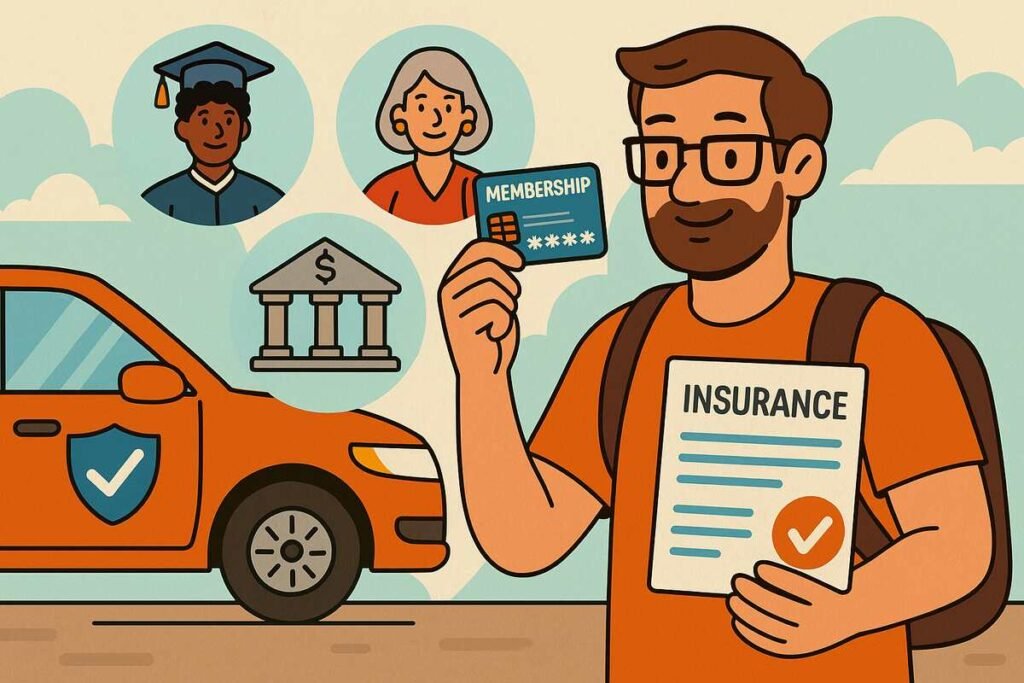
Best for: Professionals, alumni, and organization members.
Many insurance companies partner with associations, credit unions, and employers to provide affinity discounts a benefit most members never use.
Examples of Eligible Groups:
- University alumni associations (e.g., UCLA, Penn State, Michigan).
- Professional organizations (e.g., AARP, AMA, or teachers’ unions).
- Credit unions or large employers.
Example:
Marcus joined his local teachers’ association and received an 8% discount on his GEICO policy just by providing his membership ID.
Pro Tip: Always ask your HR department or alumni office if they have preferred insurer partnerships.
Research Insight: The American Automobile Association (AAA) notes that affinity-based programs can reduce premiums between 5–15%, depending on group agreements.
Takeaway: Sometimes loyalty pays off in unexpected ways.
5. Bundling and Multi-Policy Savings
Best for: Households managing multiple insurance products.
Bundling policies (like auto, home, and renters insurance) remains one of the simplest ways to unlock major savings.
Benefits of Bundling:
- Streamlined billing and renewals.
- Multi-policy discounts (usually 10–25%).
- Simplified claims management.
Example:
Jenna bundled her auto and renters insurance with State Farm and saved $480 a year, while gaining higher liability limits.
Pro Tip: Even if you already bundle, re-shop policies every two years new competitors often offer better rates for the same combo.
Research Insight: Consumer Reports found that 60% of drivers could save by switching their bundle provider after a two-year review.
Takeaway: Combining coverage simplifies your life and your expenses.
6. Vehicle Safety and Technology Discounts
Best for: Owners of newer vehicles or those with ADAS features.
Advanced Driver Assistance Systems (ADAS) not only make driving safer they make it cheaper. Many insurers now offer discounts for cars equipped with automatic braking, lane-keeping assist, and collision alerts.
Qualifying Features:
- Anti-lock brakes and airbags.
- Blind-spot detection and adaptive cruise control.
- Vehicle recovery systems like LoJack or OnStar.
Example:
Carlos’ 2025 Toyota Camry qualified for a 10% safety discount after he submitted documentation showing active ADAS features.
Pro Tip: Always provide your VIN number most insurers automatically detect eligible safety features.
Research Insight: The Insurance Institute for Highway Safety (IIHS) found that vehicles with ADAS experience 27% fewer collisions, directly influencing insurer discount policies.
Takeaway: Investing in safety technology pays off long after you drive off the lot.
7. Loyalty and Renewal Rewards
Best for: Long-term policyholders with clean driving records.
While it’s smart to compare quotes regularly, staying loyal to an insurer can also have perks, if you do it strategically.
Common Loyalty Perks:
- Lower deductible for each accident-free year.
- Renewal bonuses for consistent policyholders.
- Exclusive discounts for long-term members.
Example:
After five years with the same insurer, Robert qualified for a deductible reduction of $100 per year, eventually saving $500 off future claims.
Pro Tip: Ask your insurer about “vanishing deductible” programs they reward clean driving with cumulative savings.
Research Insight: The National Association of Insurance Commissioners (NAIC) notes that insurers with loyalty incentives have 15% higher customer retention and lower premiums for long-term drivers.
Takeaway: Sometimes, the best discount is earned through patience.
Real-Life Story: The Hidden Discounts That Added Up
Kim, a 32-year-old nurse, thought her premium was as low as it could get. But after reviewing her policy, she discovered she qualified for a work-from-home discount, an affinity program through her hospital, and vehicle safety savings. Combined, her annual premium dropped by $720 with zero change in coverage.
Lesson: The biggest savings often come from small, overlooked opportunities.
Comparison Table: Hidden Car Insurance Discounts
| Discount Type | Average Savings | Who Qualifies | Key Requirement |
|---|---|---|---|
| Telematics | 10–25% | Safe drivers | Driving app or plug-in device |
| Low-mileage | 10–15% | Remote or part-time drivers | Annual mileage under 7,500 |
| Pay-per-mile | 30–40% | City or low-use drivers | Verified mileage tracking |
| Affinity | 5–15% | Members of organizations | Proof of membership |
| Bundling | 10–25% | Multi-policy holders | Combine home/auto or renters/auto |
| Vehicle safety | 5–10% | Newer cars with ADAS | VIN verification |
| Loyalty | Up to $500 off | Long-term customers | Consistent renewals |
Frequently Asked Questions About Car Insurance Discounts
1. How do I find out which discounts I qualify for?
Ask your insurer for a full list of available discounts or use their online quote tool for customized offers.
2. Can I combine multiple discounts?
Yes, most discounts stack, such as bundling plus telematics or low-mileage programs.
3. Do newer cars always qualify for safety discounts?
Not automatically. Verify which features are included in your VIN details.
4. Will discounts affect my coverage quality?
No. Discounts lower cost, not coverage limits, unless you choose to downgrade protection.
5. How often should I review my policy for new discounts?
At least once a year or whenever your circumstances change (new job, move, or car purchase).
Final Thoughts
In 2025, discount car insurance programs are more dynamic than ever. Insurers want loyal, low-risk customers and they’re willing to reward you for proving it. From telematics to low-mileage rewards, the key is awareness: the more you know, the more you save.
If this guide helped you uncover hidden car insurance savings, share it with friends or explore more insider tips on our blog.